On Wednesday, Dec. 10, first-year engineering students showed off their creations of the semester. Over the course of the semester, students built theatre assistant robots, which would bring props and costumes to members of the show. The idea was to create robots that were small but mighty. The showcase was an opportunity for students to exhibit their hard work and the time they devoted to these robots.
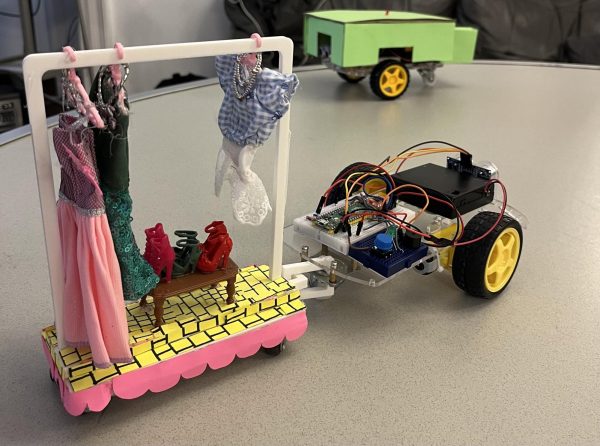
First-year computer engineering and computer science student Garima Chauhan and first-year bioengineering student Natalie Smith worked together on their robot this semester. Their robot’s name was Sparkle, and it showed in her appearance. The two bedazzled their robot with pink and silver sequins to add personality and dazzle. They hot glued false eyelashes above Sparkle’s eyes and glued pink lips to her front. On the rear of Sparkle was a vanity, where her props were stored. They spelled out Sparkle’s name in pink sequins to showcase her personality. When they signaled a certain code to begin, Sparkle would bring crew members the necessary beauty products during their productions.
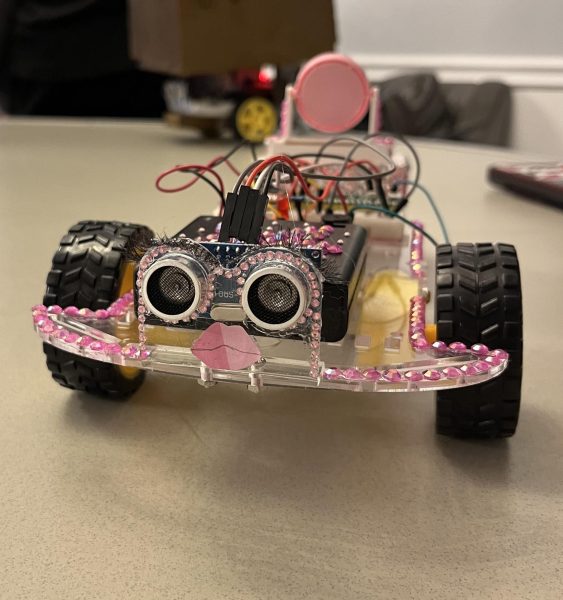
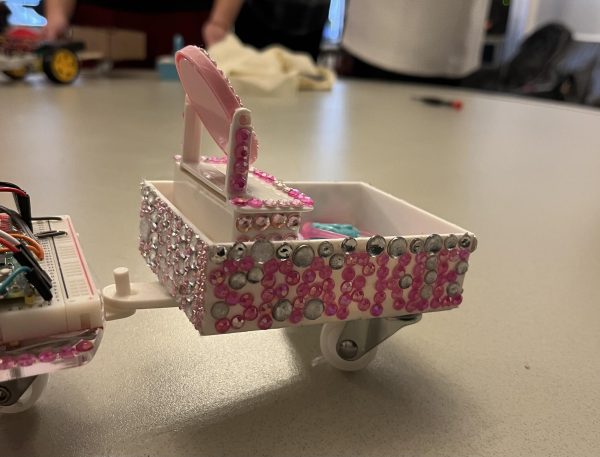
Chauhan and Smith noticed that actors and stage crew had trouble accessing their props and accessories during shows, so they designed Sparkle as a solution. “We created Sparkle, she is a vanity robot. Her job is to deliver props and the vanity in a small cart behind her to actors on stage,” says Chauhan. The pair faced struggles throughout the process, such as technical issues with coding and computer software glitches. However, they prevailed and created a successful prototype. “We created Sparkle’s cart using Fusion, an AutoCAD designing software, and then we were able to 3-D print the cart. We wired the whole robot using Raspberry Pi Pico and a circuit board,” explains Smith. With training and guidance, students were able to navigate complicated software in order to create their robots. The actual production of the robot was one thing, and the coding of it was quite another. “We gave it obstacle-detection, and we used Python code in order to encode the movements and saved them so the robot could move without being connected to a computer,” Smith clarifies. The complexity of designing a robot was tedious, but their execution was a great example of success.
The students’ showcase was a moment for their work to be recognized in an environment where learning was the priority. Students came together to cheer one another’s robots on and be graded upon the presentation and success of their robots.