As we climbed the stairs into the Brooklyn Airbnb, we heard Todd Glass’ welcoming voice crooning over soft jazz from the third floor. We stepped into the rental apartment where the smell of incense married with weed created a cozy atmosphere, and a pot on the stovetop was boiling. “I’m obsessed with ambience. You know, it really means a lot to me,” Glass later told us. There was a sense of comfort that made it immediately easy to start a conversation.
Glass, a 60-year-old comedian originally from Pennsylvania, has been doing stand-up comedy since he was 16. His most recent project, “Todd Glass: The Event of a Lifetime”, has been a labor of love for roughly four years now, and he often uses crowd sourcing to help fund his shows. His New York residency for New York Comedy Fest took place at The Second City in Brooklyn, where he performed 13 shows with a live band in an intimate theater.
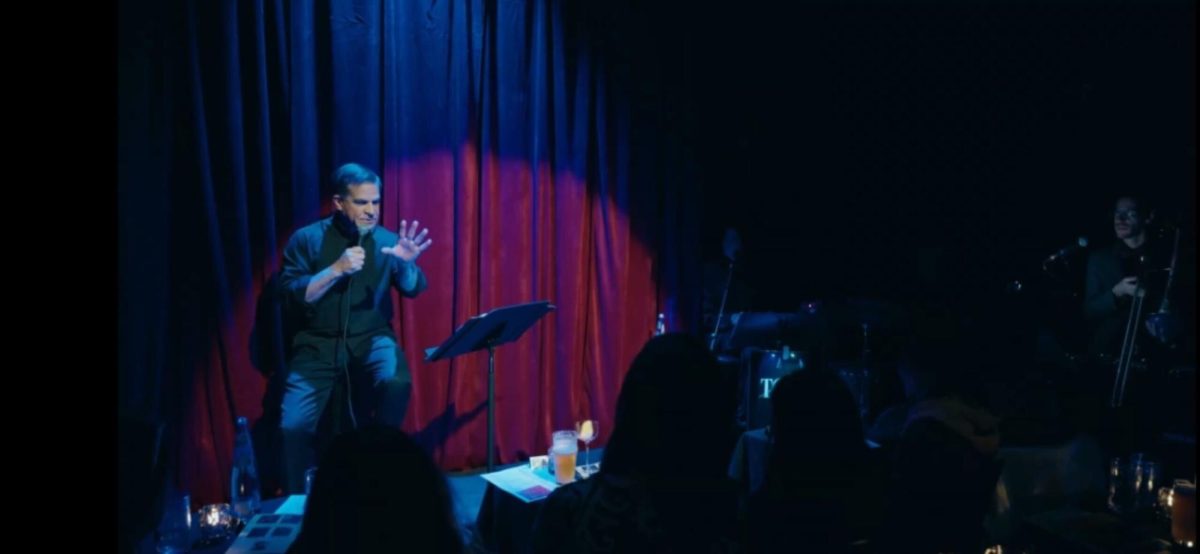
“Todd Glass: The Event of a Lifetime”, has been acclaimed by New York audiences after its run at The Second City, ending with a sold out final show that we were able to attend. The show is known for its classic comedy flair including a live band, jazz, and ambience, juxtaposed by Glass’ own riffs on the medium. Glass moves between stark observations of everyday life and personal riffs on his own experiences.
“I thought that [being gay] would become my identity, and my own manager said something great. ‘It won’t be your identity, because it’s not the most interesting thing about you’,” Glass said.
When building his set, Glass is not afraid to dive into his own life, sexuality and experiences for material.
“Comedy will change, but authenticity is really all it’s about. There’s so many people out there talking about who they are in such a more real way,” Glass said. “Nobody talked about this sh*t even 20 years ago. It’s sort of made everything better.”
The band, which acts as an integral part of the show, features the musicians as improvisers and active characters within the show who had regular thoughts and opinions throughout Glass’ set. The relationship built between Glass, the band, and the audience made the show heartwarming and fast-paced. As an audience member, you felt as if you were a part of the show when Glass or the band would ask for participation, or riff off of an audience member’s response.
Glass, a self-proclaimed lover of ambience, describes the band as powerful.
“If I had my choice, I would do the band always. They’re opening the show (as you’re) walking in, taking the stage, you know, it makes the whole thing just more exciting,” Glass said.
Closing a show is always such an emotional adventure. We know this has been a project that you’ve had in the works for many years. How does it feel to bring that to a close here in New York after a long run?
You know, honestly–putting modesty aside–I worked really hard on just the stand-up aspect of the show…it felt really good. It was fun, and it was sad, too. You know, working with that band, at the simplest, it’s f*cking fun. They’re talented musicians. They’re there for you. So having them open the show, I mean, I don’t do that show all the time. I do my own stand-up, but that’s a fun show to do, and that alone, it’s sort of sad to see it end.
When did you first get the idea for the show? And what were some of your main inspirations when you were coming up with the concept?
Any music. I always like music, you know? The band can open up the show, and in two minutes, just bring the crowd to this place that stand-up can’t do that quickly. I want people to be able to go to a show you don’t have to punch down. That doesn’t mean you can’t be crass. I like crass comedy. I like vulgar comedy…you don’t have to like white bread comedy, you know, very clean, sterile comedy. A lot of people think that’s what I am. They may see my act, and they hear me say you don’t have to punch down, so they think I’m a delicate flower. I don’t like punching people’s views. I like doing the show over [at The Second City]. I felt it was very diverse. The staff represented all types of people, and that means all types of people feel comfortable when they go to Second City. The crowds always end up being so much better.
In the weird, unprecedented, crazy times that we’re living in right now, with what we’re seeing from pressure around speech and with Kimmel and just all this pressure to conform or speak in a specific way, how do you feel like that’s impacted the comedy world or what you’re doing or how you are responding to that?
This is my favorite topic, because I think it’s necessary to hear from my perspective. Whatever I say, it probably won’t change it. Like, if you disagree with me, or you, or anybody that reads it, I don’t think it’ll change their perception. I like to think of things that aren’t social. Or political. Just change. Sometimes when they go, you know, ‘you can’t say anything anymore’, they might feel that way…the only thing that’s changed is that people can now voice back. To be a good comedian, you have to ignore the pulse of the masses sometimes. Or that crowd that night. Brilliant comedy sometimes is not met with a brilliant audience. But with that said, that doesn’t mean their outcry is always wrong. You can say more now than you ever could. Just, there’s a price you pay. People get to react.
There was a podcast episode you were on, where you explained that when you host a party, you hire a live drummer to play along with whatever music you’re playing from the speakers. And we wanted to know if there was a reason that you did that besides just for fun, or if you still do it, or…?
I had a podcast studio, and I had drums because I liked to have drummers to sit in with and be there. And I had drums because I knew they’d be in a better mood if they didn’t have to bring their [drum set]. So I got drums. I go, ‘No, I’ll have them’. And then I realized when they were playing along with live music, it sounded like the band was there. So I went, ‘Wow, just, even if you don’t have money to hire a whole band, you just have a drummer play along with [the music], even if you had a DJ, you know? And you put a monitor right behind the drummer, and they play, and people would always say when they were coming down in my backyard, they go, ‘I thought you had a band’. So that’s why I did it. And then when I had parties, I didn’t want to spend money on a whole band. I would just play music and have a drummer with it.
This one’s bringing it down just a little bit. Are there ever times that you’ve felt unsure of yourself or your set before a show or stage fright? And, how do you combat that either in the moment, before or just in general?
Maybe if there’s someone in the audience, I’m a little anxious that I want to impress. You know, there was somebody like, you know, you guys were there, there was somebody from Variety. Obviously, he’s writing an article. But I’m not nervous. I’m anxious. ‘Cause I’m prepared. Like, I am absolutely 100% prepared. So in the band, when I have them, there’s kindness between us. So I’m not nervous. I’m anxious to go out there because I know that I can, no matter what, I can go out there and do a pretty f*cking good job.
I thought it was so interesting that you have a binder of your set. That’s one of the things that I always think of when I’ve seen any stand-up shows or specials, is like, how do they remember all of this? I can go up there and do a set without the binder. I’ve done it, but the binder helps me. And again, I’m not glued to it. Sometimes you can tell when I’m a little more glued to it if it’s something new. But it’s just really the bullet points. You can’t go off the beaten path unless you have a beaten path. Could I remember it? Yeah. But I enjoy it a lot more with the binder
We wanted to ask a little bit about how you managed the nuance of your heart attack and coming out within your set. It was funny, but it was also heartwarming, and we were curious to ask how you felt your comedy changed or your life changed.
You know, everyone said my life would get better, and I always thought that mine would. One of the reasons I didn’t [come out] is because I didn’t want it to become my identity. You know, when you’re in the closet, you don’t really hide your sexuality. You hide other things that you might perceive. I care about ambiance, so I thought I may as well be honest about that. I am already honest about this. And just being, you know, true to myself is much better. Comedy will change, but authenticity is really all it’s about. And, you know, hiding who I was wasn’t really that authentic. I still think I was a good comedian, but I wasn’t very authentic. Younger people do it, and then it’s also influenced older comedians to be true to themselves. You go to open mics all over LA, and there are so many people out there talking about who they are in such a more real way. Nobody talked about this sh*t even 20 years ago. So it’s sort of made everything better.
Our last question is: What’s next?
I hope that we can come back and do the show in New York, maybe in the spring, and on a larger scale. I mean, we had a great time at Second City. They treated us great. But for what the show could be, maybe a little bigger, you know, not too big, but at a real, like, loungy type of place. And I think we would like to find a big stage for the band. We squeezed them in there, you know? We didn’t have a lot of room in there, but we squeezed the band in. And to have a little bigger band and come back and do the show would be great. That would be my dream. So you’ll know if it comes true and when the spring rolls around.