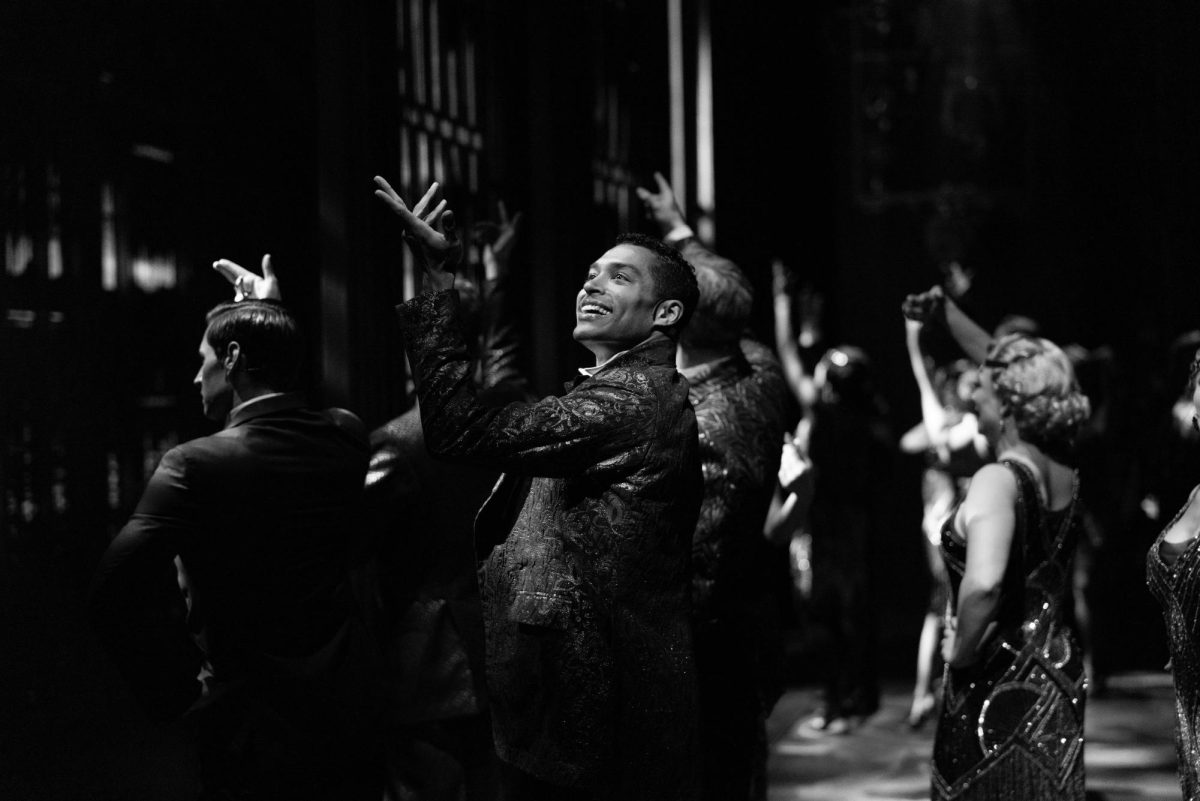
The night begins with cheering just after 7 P.M.; applause that shakes the entire theater. Nearly all of the 1,738 seats are full with eyes on the cast including Michael Maliakel, the storyteller of the evening for the Broadway Theater’s The Great Gatsby. But it’s the ensemble that ignites the fireworks with the opening song, “Roaring On.” They begin as nothing but a group of silhouettes, mannequins along a wall of green. These silhouettes are of various heights and genders, and at the end of the group, on the right side of the stage, stands an interesting figure. As the lights finally bloom, dousing the performers in silver light, our figure twirls along the stage, making himself known. He’s an anchor, lifting beautiful women into the air, yet remaining light on his feet as he travels across the large stage. Nathaniel Hunt is dressed in a black and gold suit, sparkling from head to toe and representing the love within the show through nothing more than the contact of strong, eager hands.
“I like to describe myself as a unicorn,” Hunt says. “Once upon a time I thought I was an ugly duckling, but then I think growing into myself, finding myself and my identity, I think that’s manifested to become a unicorn.”
Hunt, 34 and openly nonbinary using he/she/they pronouns, is one of the many black stars continuing to break down barriers in a year where there are still many ‘firsts’ happening such as director Ryan Coogler winning Best Original Screenplay at the BAFTAS. According to the latest Visibility Report from 2021-2022, Of the 49.8% BIPOC actors hired, Black actors represented 40.9% of all roles. Though representation has been getting better, black actors face many challenges on Broadway. For example, often, black artists are forced to tend to their own makeup and hair because backstage staff do not have proper experience. Black artists also face being singled out, such as being the only black performer in an ensemble, or given a dance belt or tights that matches a lighter complexion that isn’t theirs.
Despite these challenges, Hunt has found immense success on many stages. He has been dancing since middle school, but his dance origins originally began as a series of fun performances between him and his sister, Danielle, who is three years older than him. Growing up in Maryland, they would put on talent shows together for their parents, two solos each and two duo performances together. For a while, it was a fun game to bond with his best friend, but the older he grew, the more important it became for him.
In high school, a teacher and dance director Dianne Rosso, gave him a flyer for a masterclass at a local dance studio named Design in Motion Dance Studio. He trained there all four of his high school years. He also picked up training at Spotlight Studio of Dance, where his best friend Allie also trained, for his senior year of high school. His other major mentors alongside Rosso were the Anne Arundel Community Colleges director, Linda Fitzgerald, the director of Dance at Long Island University Brooklyn, Dana Hash, and both Earl Mosley and Matthew Rushing of EMIA and Alvin Ailey.
Hunt studied a mixture of dance-based curriculum at the Joffrey Ballet School, Cedar Lake Contemporary Ballet, the School at Jacob’s Pillows, and Early Mosley’s Institute of Arts. Hunt was dedicated to dance, seeing a true future in the art medium.
“I really feel that dance chose me as its medium, for my purpose of being here on this planet; on this floating rock in space,” he adds. He tackled ballet, classical dance techniques such as Horton, a modern dance form developed by Lester Horton designed to fortify, stretch, and strengthen the human body, aiming to correct physical limitations, and Graham, a modern dance form developed by Martha Graham that trains dancers to use torso muscles, spiraling (a core-initiated twist of the spine), and controlled falls, often contrasted with ballet’s light, upward aesthetic, and many others. Hunt graduated Summa Cum Laude with a Bachelors in Fine Arts from Long Island University Brooklyn.
In all his life, Hunt has always stood out. But it was in May 2020 where that feeling of otherness was solidified. During quarantine, there was a rise in protest pertaining to police brutality after the death of George Floyd. Hunt was one of the people that stood to the frontlines of protest. He joined together with his community, and began to raise money and teach free classes, introducing people to the world of not only dance, but art as an expressive medium.
“It was out of necessity,” Hunt explains, in reference to Noir 20/20, the initiative he took part in creating to teach the community to use art as a way to protest. “It was out of a real emotion of anger, of fear, of pain, of sorrow, and then with community and sisterhood and brotherhood and collective action.” Hunt continues to push that the youth, especially in white-dominanted art fields who do not bear these similarities to their peers, should find their community, the people that support them, especially if they are struggling to support themselves.
“I really felt a sense of family, of community, and dance really connected me to that.” He explains.
Hunt, personally, has found his people within the cast of The Great Gatsby on Broadway. While this isn’t his first time finding such close, honest relationships, this is the first time in a while where a place feels like home. It helps that this is not just a spot he’s filling in temporarily, but this a position that he was specifically hired to play. His track is a black track, meaning the casting directors were only interested in hiring a black person for this role in particular, something that is notably quite special, given the fact that as of late, race-blind casting has become predominant, rather than just black actors having a role specifically meant for them. On the night of each performance, Hunt has been seen beside Preston Taylor, a fellow performer he met during the Moulin Rouge tour, and since then, they have shared many scenes together on the Broadway Theater’s stage. The two of them have a deep connection, and while it is important to find community in people who share a similar race to you, it is also important to find people who simply care and have the ability to lend their ears and heart, not just their opinions. The Great Gatsby is a space that is diverse, and the voices of all are attempted to be uplifted, and while things may not always be perfect, they are openly taking steps in the right direction.
“Continue to discover who you are because magic happened for you to be here, and thus, there’s magic inside of us, and what an adventure it is and can be to explore and share that magic.”